OmicsFlow
🧬 OmicsFlow
A modular, containerized NGS pipeline for RNA-seq, long-read, and metagenomic analysis



📋 Overview
OmicsFlow is a production-ready bioinformatics pipeline built with Nextflow and Docker, designed for reproducible multi-omics data analysis. It supports three major sequencing technologies:
| Workflow | Technology | Key tools | Status |
|---|---|---|---|
rnaseq.nf |
Illumina short reads | FastQC · STAR · Salmon · DESeq2 | ✅ Stable |
longread.nf |
Oxford Nanopore (ONT) | NanoStat · Minimap2 · Samtools | 🚧 In development |
metagenomics.nf |
Illumina / ONT | Kraken2 · Bracken | 🚧 In development |
All workflows are fully containerized via Docker and can run locally, on HPC clusters (SLURM/PBS), or in the cloud (AWS Batch).
📸 Pipeline Results
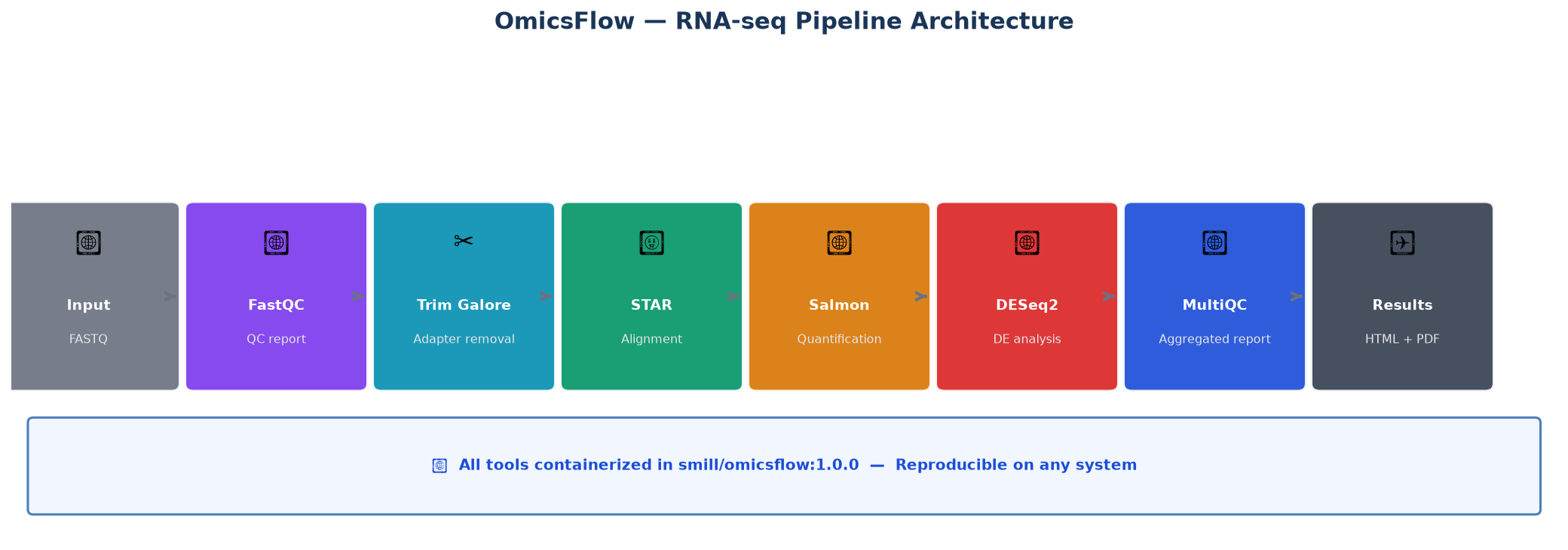
Pipeline Architecture
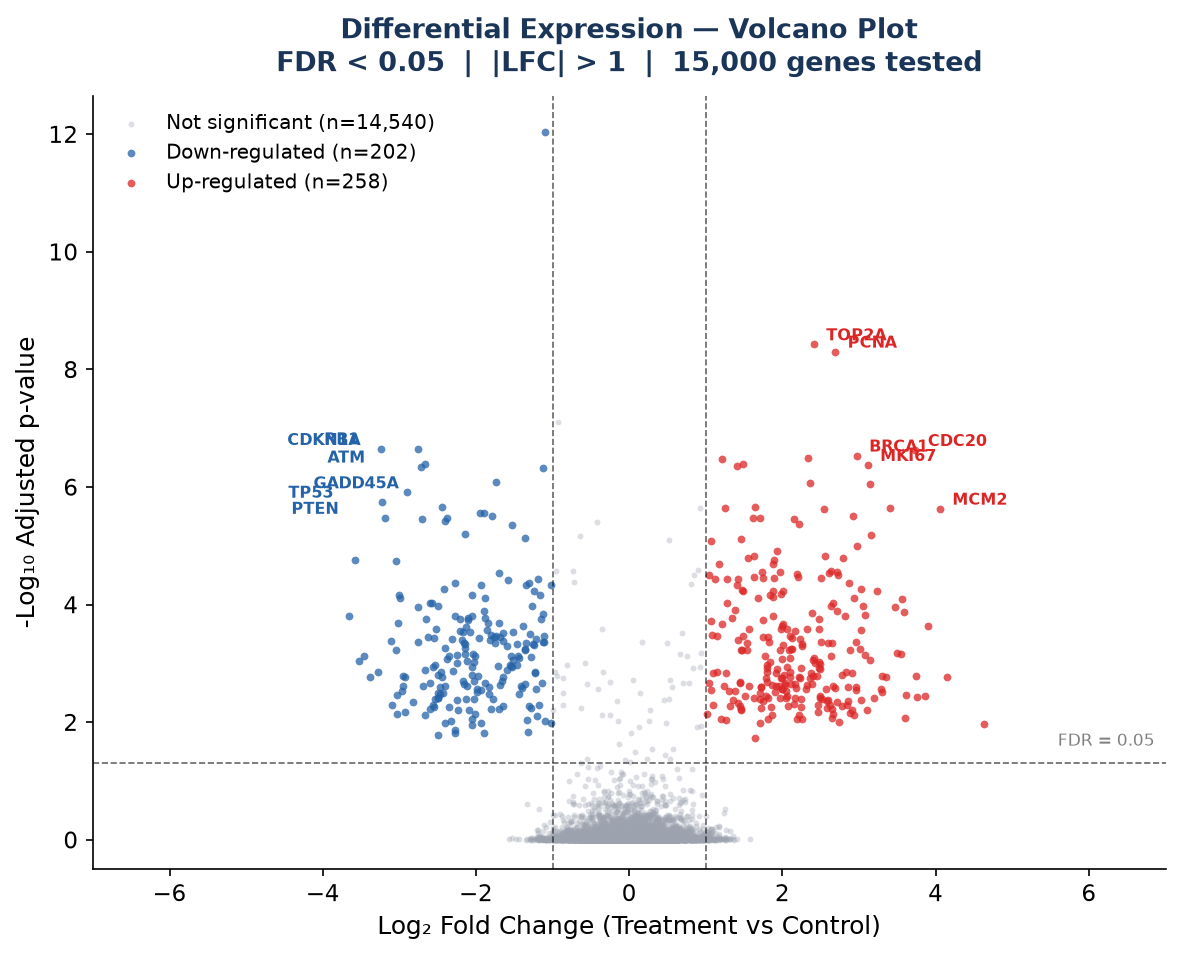
Differential Expression — Volcano Plot
Top 50 DE Genes — Heatmap

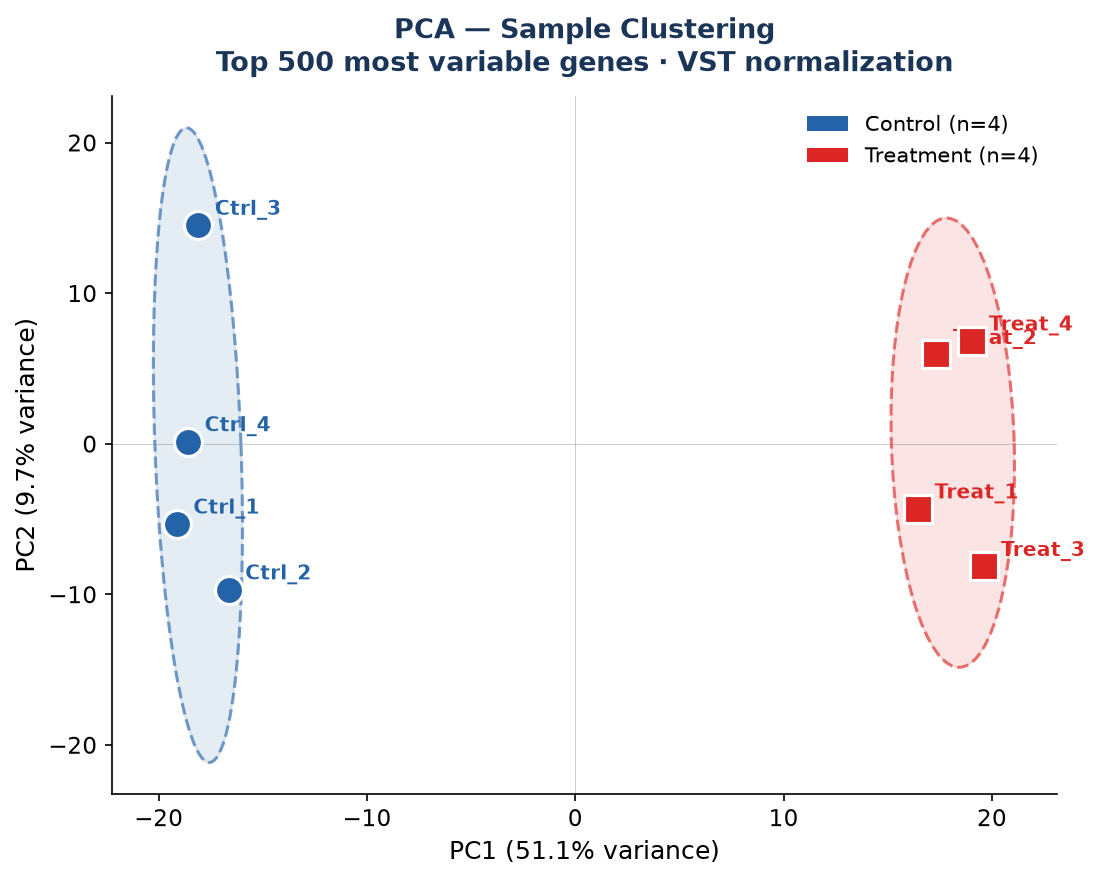
Sample Clustering — PCA
📊 Validation Metrics
Benchmarked on nf-core test dataset (S. cerevisiae, GSE110004, 4 samples × 50,000 reads):
| Metric | Value |
|---|---|
| Input reads per sample | 50,000 |
| Reads passing QC | 99.5% |
| Adapter contamination (auto-detected & removed) | 40.3% |
| Uniquely mapped reads (STAR) | 81.8% – 84.6% |
| Properly paired reads | 100% |
| Mismatch rate | 0.9% |
| Pipeline execution time (4 samples, 4 CPUs) | ~8 min |
| Docker image size | 4.63 GB |
🚀 Quick Start — Run in 3 steps
Step 1 — Pull the Docker image
docker pull smill/omicsflow:1.0.0
Step 2 — Prepare your samplesheet
Create a CSV file with your samples:
sample,fastq_1,fastq_2,strandedness,condition
ctrl_rep1,/data/ctrl_rep1_R1.fastq.gz,/data/ctrl_rep1_R2.fastq.gz,reverse,control
ctrl_rep2,/data/ctrl_rep2_R1.fastq.gz,/data/ctrl_rep2_R2.fastq.gz,reverse,control
treat_rep1,/data/treat_rep1_R1.fastq.gz,/data/treat_rep1_R2.fastq.gz,reverse,treatment
treat_rep2,/data/treat_rep2_R1.fastq.gz,/data/treat_rep2_R2.fastq.gz,reverse,treatment
Strandedness:
reversefor most Illumina TruSeq kits ·forwardfor some stranded protocols ·unstrandedif unsure
Step 3 — Run the pipeline
nextflow run Millimono/OmicsFlow \
  --input samplesheet.csv \
  --star_index /data/star_index \
  --salmon_index /data/salmon_index \
  --outdir results/ \
  -profile docker
Windows users: replace
$(pwd)with%cd%in CMD
Need to build reference indexes first? Use the one-command script:
docker run --rm -v $(pwd):/data smill/omicsflow:1.0.0 \
  bash /data/scripts/prepare_references.sh \
  --genome /data/genome.fa \
  --gtf    /data/genes.gtf \
  --outdir /data/references/
# → builds star_index/ + salmon_index/ + tx2gene.csv automatically
Then run the pipeline with
--star_index references/star_index --salmon_index references/salmon_index --tx2gene references/tx2gene.csv
📦 What you need before starting
OmicsFlow is flexible — you can use the full pipeline or individual tools depending on your needs.
Requirements per use case
| Use case | What you need |
|---|---|
| Quality control only | FASTQ files |
| Trimming only | FASTQ files |
| Alignment (STAR) | FASTQ files + STAR index |
| Quantification (Salmon) | FASTQ files + Salmon index |
| Full RNA-seq (FASTQ → DE genes) | FASTQ + STAR index + Salmon index + tx2gene.csv |
| Statistics on existing BAM | BAM file |
| Python / R analysis | Your own data + scripts |
A. Reference genome & STAR index
If you already have a STAR index on your server — point to it with --star_index. No need to rebuild.
If you need to build one:
# 1. Download reference genome (example: human GRCh38)
wget https://ftp.ensembl.org/pub/release-109/fasta/homo_sapiens/dna/Homo_sapiens.GRCh38.dna.primary_assembly.fa.gz

# 2. Download gene annotation
wget https://ftp.ensembl.org/pub/release-109/gtf/homo_sapiens/Homo_sapiens.GRCh38.109.gtf.gz
gunzip Homo_sapiens.GRCh38.109.gtf.gz

# 3. Build STAR index using OmicsFlow Docker
docker run --rm -v $(pwd):/data smill/omicsflow:1.0.0 \
  bash -c "mkdir -p /data/star_index && STAR --runMode genomeGenerate \
  --genomeDir /data/star_index \
  --genomeFastaFiles /data/genome/GRCh38.fa \
  --sjdbGTFfile /data/genome/GRCh38.gtf \
  --runThreadN 8"
⚠️ Build the STAR index once per genome, then reuse it for all experiments. Any STAR-compatible index works — it does not need to be built with this Docker image.
B. Salmon index
# 1. Download transcriptome FASTA
wget https://ftp.ensembl.org/pub/release-109/fasta/homo_sapiens/cdna/Homo_sapiens.GRCh38.cdna.all.fa.gz

# 2. Build Salmon index
docker run --rm -v $(pwd):/data smill/omicsflow:1.0.0 \
  bash -c "export LC_ALL=C && salmon index \
  -t /data/transcriptome.fa.gz \
  -i /data/salmon_index \
  --threads 8"
C. tx2gene.csv (required for gene-level DESeq2)
This file maps transcript IDs to gene IDs — required for Salmon → DESeq2 gene-level summarization.
Generate automatically from your GTF:
docker run --rm -v $(pwd):/data smill/omicsflow:1.0.0 \
  python3 /data/scripts/generate_tx2gene.py \
  --gtf /data/genes.gtf \
  --output /data/tx2gene.csv
Or use the one-liner:
docker run --rm -v $(pwd):/data smill/omicsflow:1.0.0 \
  bash -c "python3 -c \"
import re
with open('/data/genes.gtf') as f, open('/data/tx2gene.csv','w') as out:
    out.write('tx_id,gene_id\n')
    for line in f:
        if '\ttranscript\t' in line:
            tx = re.search('transcript_id \\\"([^\\\"]+)\\\"', line)
            gn = re.search('gene_id \\\"([^\\\"]+)\\\"', line)
            if tx and gn:
                out.write(f'{tx.group(1)},{gn.group(1)}\n')
\""
Then pass it to the pipeline:
nextflow run Millimono/OmicsFlow \
  --input samplesheet.csv \
  --star_index /data/star_index \
  --salmon_index /data/salmon_index \
  --tx2gene /data/tx2gene.csv \
  --outdir results/ \
  -profile docker
D. What you do NOT need to install
Everything is already inside the Docker image smill/omicsflow:1.0.0:
| Tool | Without OmicsFlow | With OmicsFlow |
|---|---|---|
| FastQC | Manual install | ✅ Included |
| Trim Galore | Manual install | ✅ Included |
| STAR | Compile from source | ✅ Included |
| Salmon | Manual install | ✅ Included |
| Samtools | Compile from source | ✅ Included |
| DESeq2 | R + Bioconductor setup | ✅ Included |
| MultiQC | pip install | ✅ Included |
| BioPython | pip install | ✅ Included |
| numpy / pandas / matplotlib | pip install | ✅ Included |
| NanoStat / NanoPlot | pip install | ✅ Included |
| Kraken2 | Manual install | ✅ Included |
| Minimap2 | Manual install | ✅ Included |
🐳 Run with Docker only (no Nextflow required)
# Pull the image
docker pull smill/omicsflow:1.0.0

# Step 1 — Quality control
docker run --rm -v $(pwd)/data:/data smill/omicsflow:1.0.0 \
  bash -c "fastqc /data/*.fastq.gz --outdir /data/qc"

# Step 2 — Adapter trimming
docker run --rm -v $(pwd)/data:/data smill/omicsflow:1.0.0 \
  bash -c "trim_galore --paired --cores 4 \
  /data/sample_R1.fastq.gz /data/sample_R2.fastq.gz -o /data/trimmed"

# Step 3 — Alignment
docker run --rm -v $(pwd)/data:/data smill/omicsflow:1.0.0 \
  bash -c "STAR --runMode alignReads \
  --genomeDir /data/star_index \
  --readFilesIn /data/trimmed/sample_R1_val_1.fq.gz /data/trimmed/sample_R2_val_2.fq.gz \
  --readFilesCommand zcat \
  --outSAMtype BAM SortedByCoordinate \
  --outFileNamePrefix /data/aligned/sample. \
  --runThreadN 4"

# Step 4 — Quantification
docker run --rm -v $(pwd)/data:/data smill/omicsflow:1.0.0 \
  bash -c "export LC_ALL=C && salmon quant \
  --index /data/salmon_index \
  --libType A \
  -1 /data/trimmed/sample_R1_val_1.fq.gz \
  -2 /data/trimmed/sample_R2_val_2.fq.gz \
  --output /data/counts/sample \
  --threads 4 --validateMappings"

# Step 5 — BAM statistics
docker run --rm -v $(pwd)/data:/data smill/omicsflow:1.0.0 \
  bash -c "samtools flagstat /data/aligned/sample.Aligned.sortedByCoord.out.bam"

# Step 6 — Aggregated QC report
docker run --rm -v $(pwd)/data:/data smill/omicsflow:1.0.0 \
  bash -c "export LC_ALL=C.UTF-8 && multiqc /data --outdir /data/multiqc"

# Interactive R session (DESeq2, ggplot2...)
docker run --rm -it -v $(pwd)/data:/data smill/omicsflow:1.0.0 R

# Interactive Python session (biopython, pandas, matplotlib...)
docker run --rm -it -v $(pwd)/data:/data smill/omicsflow:1.0.0 python3
Windows users: replace
$(pwd)with%cd%
🚀 Run with Nextflow (recommended for production)
Prerequisites
Full RNA-seq pipeline
# Clone the repository
git clone https://github.com/Millimono/OmicsFlow.git
cd OmicsFlow

# Run with all options
nextflow run rnaseq.nf \
  --input data/test/samplesheet.csv \
  --star_index /data/star_index \
  --salmon_index /data/salmon_index \
  --tx2gene /data/tx2gene.csv \
  --outdir results/ \
  --fdr_cutoff 0.05 \
  --lfc_threshold 1.0 \
  -profile docker
Skip DESeq2 (alignment + quantification only)
nextflow run rnaseq.nf \
  --input samplesheet.csv \
  --star_index /data/star_index \
  --salmon_index /data/salmon_index \
  --skip_deseq2 \
  --outdir results/ \
  -profile docker
Run on HPC cluster (SLURM)
nextflow run rnaseq.nf \
  --input samplesheet.csv \
  --star_index /data/star_index \
  --salmon_index /data/salmon_index \
  --tx2gene /data/tx2gene.csv \
  --outdir results/ \
  -profile cluster
All parameters
| Parameter | Default | Description |
|---|---|---|
--input |
required | Path to samplesheet CSV |
--star_index |
null | Path to STAR genome index |
--salmon_index |
null | Path to Salmon transcriptome index |
--tx2gene |
null | Path to tx2gene.csv (transcript→gene) |
--outdir |
results | Output directory |
--fdr_cutoff |
0.05 | DESeq2 FDR threshold |
--lfc_threshold |
1.0 | DESeq2 log2 fold-change threshold |
--min_counts |
10 | Minimum counts filter for DESeq2 |
--skip_trimming |
false | Skip Trim Galore step |
--skip_fastqc |
false | Skip FastQC step |
--skip_deseq2 |
false | Skip DESeq2 step |
--skip_multiqc |
false | Skip MultiQC step |
🗂️ Project Structure
OmicsFlow/
├── rnaseq.nf                    # ✅ RNA-seq pipeline (stable)
├── workflows/
│   ├── longread.nf              # 🚧 Nanopore pipeline (in development)
│   └── metagenomics.nf          # 🚧 Metagenomic pipeline (in development)
├── modules/
│   ├── qc/                      # FastQC, MultiQC, Trim Galore
│   ├── alignment/               # STAR, Samtools, Minimap2
│   └── quantification/          # Salmon, DESeq2
├── analysis/
│   ├── deseq2.R                 # Standalone DESeq2 script
│   ├── plots.py                 # Visualization scripts
│   └── report.Rmd               # HTML report template
├── scripts/
│   ├── prepare_references.sh    # Build STAR + Salmon index + tx2gene in one command
│   └── generate_tx2gene.py      # Generate tx2gene.csv from GTF
├── containers/
│   └── Dockerfile               # Reproducible environment
├── data/test/
│   └── samplesheet.csv          # Example samplesheet
├── docs/
│   ├── usage.md                 # Full usage guide
│   └── images/                  # Pipeline figures
├── .github/workflows/ci.yml     # GitHub Actions CI/CD
└── nextflow.config              # Execution profiles
📈 Results & Outputs
results/
├── qc/
│   ├── fastqc/                  # Per-sample FastQC HTML reports
│   └── multiqc_report.html      # Aggregated QC report
├── trimmed/
│   └── logs/                    # Trim Galore reports
├── aligned/
│   ├── sample.Aligned.sortedByCoord.out.bam
│   └── sample.Log.final.out     # Mapping statistics
├── counts/
│   └── salmon/quant.sf          # Transcript-level counts
├── deseq2/
│   ├── deseq2_results.csv       # DE genes table
│   ├── normalized_counts.csv    # VST-normalized counts
│   ├── volcano_plot.pdf         # Volcano plot
│   ├── heatmap_top50.pdf        # Top 50 DE genes
│   └── pca_plot.pdf             # Sample clustering PCA
└── pipeline_info/
    ├── execution_report.html
    └── execution_timeline.html
📊 Workflows in Detail
1. RNA-seq Pipeline (rnaseq.nf) ✅ Stable
Input FASTQ
    │
    ▼
[FastQC] ──────────────────────> QC report
    │
    ▼
[Trim Galore] ──> Trimmed reads
    │
    ├──────────────────────────────────────────┐
    ▼                                          ▼
[STAR] ──> BAM ──> [Samtools]          [Salmon] ──> quant.sf
           (QC + IGV visualization)         │
                                            ▼
                                    [tximport] ──> [DESeq2]
                                                       │
                                                       ▼
                                            volcano · heatmap · PCA
    │
    ▼
[MultiQC] ──> Aggregated HTML report
2. Long-read Pipeline (longread.nf) 🚧 In development
Tools already available in Docker — Nextflow modules coming soon.
# Use individually now:
docker run --rm -v $(pwd):/data smill/omicsflow:1.0.0 \
  bash -c "NanoStat --fastq /data/sample.fastq.gz"

docker run --rm -v $(pwd):/data smill/omicsflow:1.0.0 \
  bash -c "minimap2 -ax splice /data/reference.fa /data/sample.fastq.gz \
  | samtools sort -o /data/aligned.bam"
3. Metagenomic Pipeline (metagenomics.nf) 🚧 In development
Kraken2 already available in Docker — Nextflow modules coming soon.
# Use individually now:
docker run --rm -v $(pwd):/data smill/omicsflow:1.0.0 \
  bash -c "kraken2 --db /data/kraken2_db --paired \
  /data/R1.fastq.gz /data/R2.fastq.gz \
  --output /data/kraken2_output.txt \
  --report /data/kraken2_report.txt"
🛠️ Technical Stack
| Category | Tools | Versions |
|---|---|---|
| Pipeline orchestration | Nextflow DSL2 | ≥ 22.10 |
| Containerization | Docker · Singularity | 28.x |
| QC | FastQC · MultiQC · NanoStat · NanoPlot | 0.12.1 · 1.35 · 1.6.0 |
| Alignment | STAR · Minimap2 | 2.7.11b · 2.31 |
| Quantification | Salmon | 1.12.0 |
| Variant calling | Samtools · BCFtools | 1.23.1 |
| Metagenomics | Kraken2 | 2.1.3 |
| Statistical analysis | DESeq2 · tximport · R | R 4.5.2 |
| Visualization | ggplot2 · matplotlib · seaborn | — |
| Languages | Python · R · Bash · C · C++ | Python 3.x |
| CI/CD | GitHub Actions | — |
| Documentation | GitHub Pages | — |
🧪 Test Data
| Dataset | Source | Size | Used for |
|---|---|---|---|
| GSE110004 / SRR6357070-71 (4 samples) | nf-core test datasets | ~8 MB | RNA-seq validation |
| S. cerevisiae R64-1-1 genome | nf-core test datasets | ~230 KB | Reference genome |
| S. cerevisiae gene annotation | nf-core test datasets | ~200 KB | Gene annotation |
⚙️ Configuration Profiles
profiles {
    docker  { docker.enabled = true; process.executor = 'local' }
    cluster { process.executor = 'slurm'; singularity.enabled = true }
    cloud   { process.executor = 'awsbatch'; aws.region = 'ca-central-1' }
    test    { params.input = "${projectDir}/data/test/samplesheet.csv" }
    stub    { /* CI testing without real tools */ }
}
🔗 Link to Research
- MalariaScan — AI detection of malaria. Prix Jean-Marc Léger, UdeM 2025.
- HAtt-CNN — Adaptive visual attention for CNN interpretability. (Under review 2026)
- EpitopeNet — Prototype learning for mammography classification. (Under review 2026)
→ github.com/Millimono/EpitopeNet
📚 Documentation
Full documentation: millimono.github.io/OmicsFlow
📄 Citation
Millimono, S. (2026). OmicsFlow: A modular containerized NGS pipeline
for reproducible multi-omics analysis (v1.0.2). Zenodo.
https://doi.org/10.5281/zenodo.20805475
👤 Author
Sory Millimono — PhD Candidate in AI · Bioinformatician
Mohammed V University – ENSIAS · Université de Montréal
- 📧 millimono64.sm@gmail.com
- 🎓 Google Scholar — h-index 1 · 24 citations
- 🔬 ORCID: 0009-0005-1960-9136
📜 License
MIT License — see LICENSE for details.